Profile and general status
The Profile is the main status screen in BoardMasters. It brings together company progress, gems, active bonuses, portfolio summary, stock price information and relevant updates so you can quickly understand how your position is evolving inside the simulation.
What the Profile is
The Profile is the main status panel inside BoardMasters. Its purpose is to show, in one screen, the most important information about the company you control and your current position inside the simulation.
From this screen you can review current progress, level, company status, available gems, active bonuses, stock portfolio, company stock price and relevant updates related to your investments.
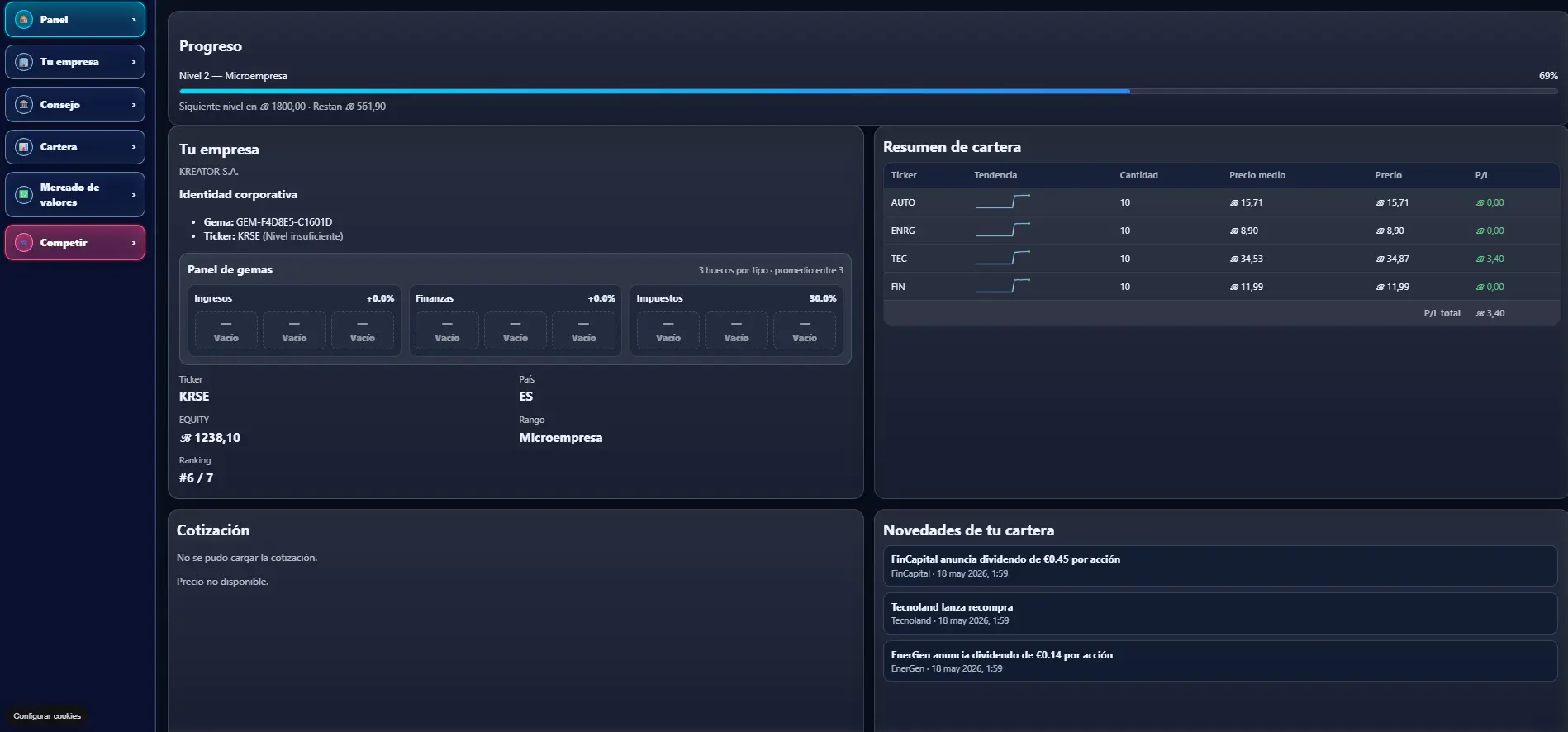
The main purpose of the Profile is to work as an operational summary. Before making important decisions, this screen helps you check whether the company is growing, what resources it has available and which events may affect its evolution.
Progress and level
The progress block shows the general advancement status of the company. It displays the current level, the progress percentage and the approximate distance to the next threshold.
This indicator helps you understand where the company stands inside the simulation. It is not only a visual element: it summarizes accumulated growth and helps compare the company’s current state with its next objectives.
Reviewing progress is useful to know whether the company is close to improving its rank, unlocking new possibilities or strengthening its competitive position inside the game.
Company identity and status
The Profile also displays the company’s corporate identity: name, ticker, country, equity, rank and leaderboard position. These details help you quickly recognize which company you are managing and what its current status is.
The ticker identifies the company inside the market. When the company has not gone public yet, the ticker may appear as an internal reference or as a status that is not fully active in the stock market.
Equity represents the estimated net worth of the company inside BoardMasters. It is a key reference for measuring its size, progress and position compared with other companies.
Rank and leaderboard position help interpret the company in a competitive context. They do not only show an isolated number, but how the company stands compared with other participants.
Gems panel and bonuses
Every company is born with one gem. Gems are special elements that can provide bonuses to the company and become part of its competitive advantage inside the simulation.
Each gem has two main parameters: a type and a level. The type can be operational, financial or tax-related. The level goes from 6 to 10, and the higher the level, the stronger the potential effect of the gem.
The gems panel can hold up to nine gems in total: three operational gems, three financial gems and three tax gems. Each group affects a different part of the company.
Operational gems can improve aspects related to business activity. Financial gems affect financial results. Tax gems help reduce the tax impact on the company.
If a company has several gems of the same type, the bonus is calculated using the average of the gems placed in that group. For example, three tax gems generate an average tax bonus. If you have one financial gem and two tax gems, the company will have both a financial bonus and a tax bonus at the same time.
To obtain more gems, a company must absorb other companies. When a company absorbs another one, it keeps its gem and can add it to its own panel. This makes gems part of growth, acquisition and corporate control strategy.
Portfolio summary
The portfolio summary shows a quick view of the shares owned by the company. It includes tickers, quantity, average purchase price, current price and accumulated profit or loss.
This information helps you immediately understand how the company’s investments are performing. A portfolio can include several companies, and each position can have a different gain or loss.
The trend column helps visually interpret recent movement in the asset. The P/L value shows whether the position is generating a profit or a loss compared with the average entry price.
Company stock price
The stock price block provides a summarized view of your own company’s market performance. This section becomes useful only when the company has already gone public.
If the company is not listed yet, the Profile may show a message saying that no price is available or that the stock price could not be loaded. This does not mean the company does not exist; it means it does not yet have an active market reference.
When the company is listed, this section lets you quickly review the current price and recent evolution. It is a simple way to follow how the market values the company inside the simulation.
Portfolio updates
The portfolio updates section collects news related to the companies held in your portfolio. Its purpose is to alert you about events that may affect your investments.
This area may include dividend announcements, debt issues, buybacks, takeover offers and other relevant corporate events. Each update helps explain what is happening with the companies in which you have exposure.
Reviewing updates is important because many investment decisions do not depend only on the current price. A dividend, capital increase, bond issue or takeover offer can change how a portfolio position should be interpreted.
Profile FAQ
Does the Profile show player data or company data? The Profile mainly summarizes the active company status, although some elements may depend on the selected actor inside BoardMasters.
Why may the stock price not appear? Because the company may not have gone public yet, or because no market data is available at that moment.
Can gems be bought directly? No. Gems belong to companies. To obtain more gems, a company must absorb other companies and keep their gems.
Why should I review the Profile? It helps you understand the general state of the company before making decisions: growth, bonuses, portfolio, stock price and relevant events.